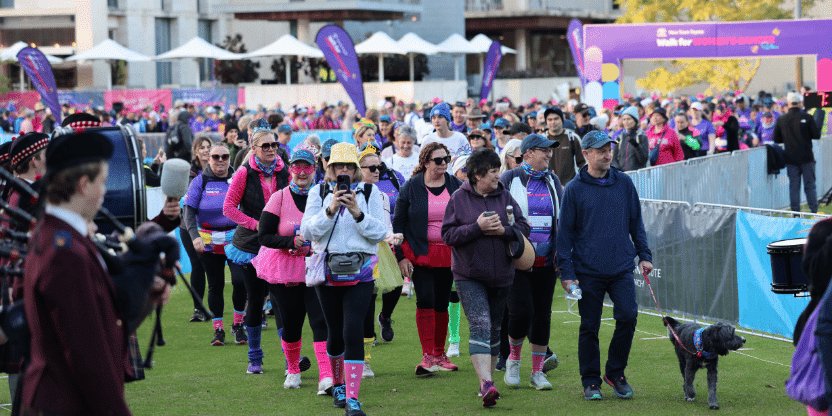
More than 1200 Walkers hit the streets around Perth today for the New Town Toyota Walk for Women’s Cancer, starting and finishing at Riley Oval at UWA. Together, they have raised over $1.52m for cancer research in WA.
The walk benefits women’s cancer research at the Harry Perkins Institute of Medical Research and is an opportunity to take meaningful steps toward a future where women’s cancer including breast and ovarian cancer could become non-lethal.
This year the Walkers tackled the 35km or 42km Walk course in one go, or they had the option to spread the kilometres out walking 5km a day over six days and completing the final 5km on Walk Day.
Plenty of honeybees were also celebrated at the Walk. This is because Perkins researchers Associate Professor Pilar Blancafort and her team made international headlines in 2020 when they discovered that a component in honeybee venom, melittin, was found to kill aggressive breast cancer cells.
Their results revealed that honeybee venom rapidly destroyed triple-negative breast cancer and HER2-enriched breast cancer cells – some of the most hard-to-treat cancer cells.
Today, Dr Edina Wang is leading this research. She is enhancing the melittin compound by adding targeting components that help it better recognise and attack cancer cells. So far, these improvements have shown impressive results. In addition to breast cancer, Dr Wang is now testing the compound on ovarian cancer cells, where it has demonstrated a six-fold improvement in anti-cancer effectiveness compared to melittin alone.
Perkins CEO, Professor Peter Leedman AO, said the Walkers are single minded in their pursuit of better cancer prevention and treatments.
“At the Walk we support those who are currently battling cancer.
“We want to make a difference to those who will face it in the future, and we remember the women who are no longer with us.
“We have some of the most amazing women’s cancer researchers at the Perkins.
“These amazing individuals taking part in the Walk are the engine that drives the Perkins and for that, we are immensely grateful,” Professor Leedman said.
Simply, the Walk can be summed up in one sentence: “We may start the walk as strangers, but we end it as family.”