
Researchers developing innovative technology for early heart disease detection have received more than $298,000 from the Heart Foundation’s 2026 research funding program.
They have been awarded Vanguard Grants to test the feasibility of innovative, non-invasive technology with the aim to improve cardiovascular health.
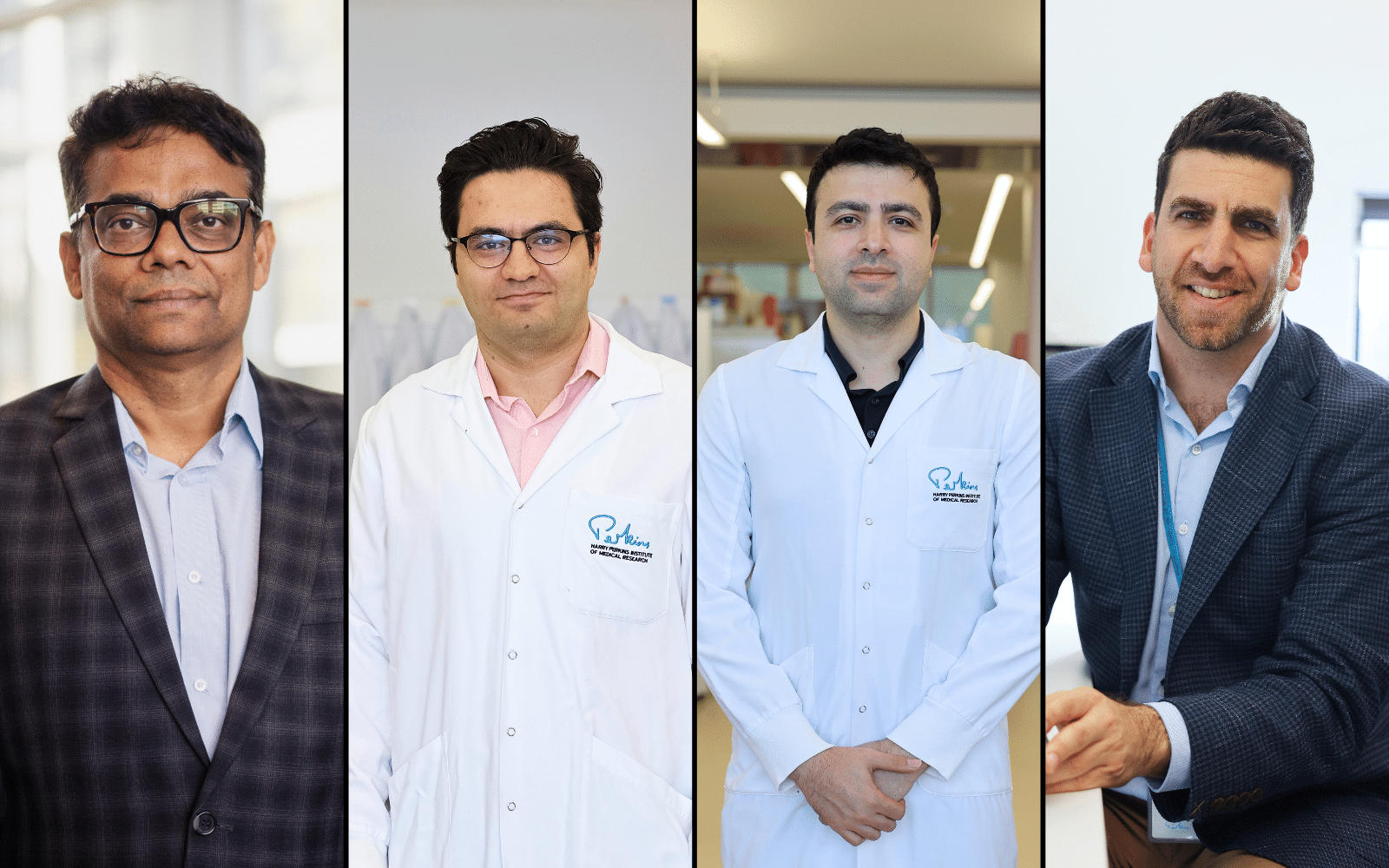
Professor Girish Dwivedi, head of the Cardiovascular Science and Diabetes Program at the Harry Perkins Institute of Medical Research (APEX Heart Lab); Dr Hadi Afsharan; a biomedical engineer, researcher and Research Fellow in Cardiovascular Science and Diabetes at the Perkins (APEX Heart Lab) and Dr Ebrahim Vahabli, mechanical engineer and postdoctoral research associate at the Perkins (APEX Heart Lab) and all from UWA’s Medical School were awarded funding to develop a wearable radar sensor to continuously and non-invasively measure pressure changes in the neck veins, helping to detect heart failure earlier.
Associate Professor Abdul Ihdayhid, Group Leader of the Cardiovascular Research and Innovation Lab at the Perkins, was also awarded a Vanguard Grant for his innovative project that aims to use AI to reduce misdiagnosis of spontaneous coronary artery dissection.
Dr Afsharan, Professor Dwivedi and Associate Professor Barry Cense, from UWA’s School of Engineering, received funds for a study to investigate whether an advanced retinal imaging technique could be used as a screening tool for coronary artery disease.
Heart disease remains a leading cause of death in Australia, responsible for one in four lives lost each year.
The Heart Foundation announced $14.5 million in funding for 67 heart research projects across Australia, supporting discoveries that could transform how heart disease is prevented, detected and treated.
Dr Anna Calkin, National Manager Research for the National Heart Foundation, congratulated the outstanding researchers who received funding.
“Behind every project is the potential to deepen our understanding of heart disease and ultimately improve the lives of people affected by it,” Dr Calkin said.
“Investing in research helps advance new and better ways to prevent heart disease, detect it earlier, and improve the treatment and care of people living with heart disease.”
The funding will support research spanning early detection, personalised treatment, women’s heart health, First Nations-focused research, artificial intelligence, stroke recovery and next-generation therapies.
The Heart Foundation is Australia’s largest non-government funder of heart disease research and has funded heart research for more than 60 years, investing more than $900 million in today’s dollars to date.